Headless Web Design Chicago: 2026 Guide
If your Chicago business website takes more than 2 seconds to load, you are losing 53% of your visitors before they even see your homepage. That is not speculation — it is Google's own data on page speed and user behavior.
In 2026, the gap between businesses with fast websites and slow ones has never been wider. Headless web design is the technology closing that gap — and Chicago businesses adopting it early are dominating their competition in search rankings, conversions, and revenue.
This is the most comprehensive guide to headless web design for Chicago businesses. Whether you run a law firm in the Loop, an e-commerce store in Naperville, or a restaurant chain in Schaumburg, this guide will show you exactly why headless architecture matters and how to implement it.
What Is Headless Web Design?
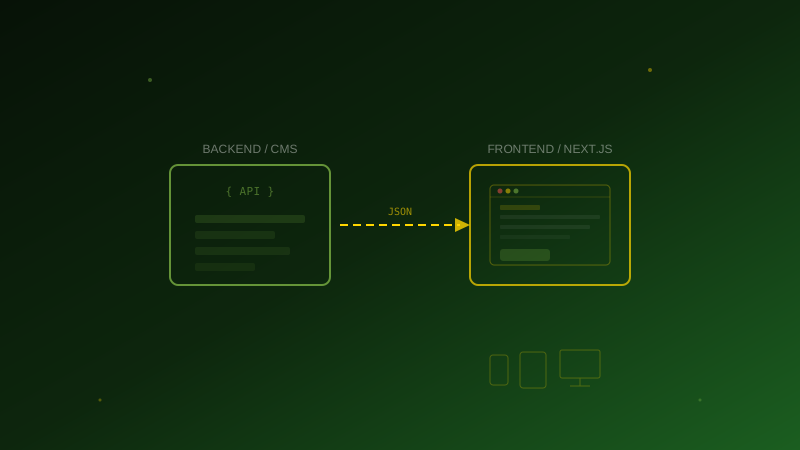
Headless web design is an architecture where the frontend (what visitors see and interact with) is completely separated from the backend (where content is stored and managed). They communicate through APIs — fast, secure data pipelines that deliver content instantly.
Think of it this way:
- Traditional website (WordPress, Wix, Squarespace) — the frontend and backend are one system. When a visitor loads your page, the server has to build it from scratch every time. This is slow.
- Headless website (Next.js + CMS) — pages are pre-built at deploy time and served from a global CDN. When a visitor loads your page, it is already ready. This is blazing fast.
The word "headless" means the CMS has no "head" — no built-in frontend. Instead, you choose the fastest, most modern frontend technology available and connect it to any CMS you want.
How Headless Architecture Works (Technical Breakdown)
Here is the exact architecture we build for Chicago businesses:
- Content Management System (Backend) — WordPress, Sanity, Contentful, or Strapi. Your team writes and manages content here, just like they always have.
- API Layer — REST or GraphQL APIs deliver content as structured data (JSON). No HTML, no CSS, no bloat — just pure data.
- Frontend Framework — Next.js with React renders that data into beautiful, interactive pages. Pages are statically generated at build time for maximum speed.
- CDN Delivery — Finished pages are deployed to a global Content Delivery Network (Vercel, Cloudflare, or AWS). Your Chicago visitors get content from a server in Chicago, not from a shared hosting box in Virginia.
- Incremental Static Regeneration (ISR) — When you update content in the CMS, only the changed pages rebuild. No full site rebuilds needed.
The result: a website that scores 95-100 on Google PageSpeed, loads in under 1 second, and handles millions of visitors without breaking a sweat.
For the technical details on optimizing speed further, read our guide: How to Improve Website Speed and Google PageSpeed Score in 2026.
Headless vs Traditional WordPress: Side-by-Side Comparison
| Feature | Traditional WordPress | Headless (Next.js + CMS) |
|---|---|---|
| Page Load Time | 3-8 seconds | 0.3-1.2 seconds |
| Google PageSpeed Score | 30-65 | 90-100 |
| Core Web Vitals | Often failing | All green |
| Security | High attack surface (plugins, themes, admin panel) | Minimal attack surface (static files, no admin) |
| Scalability | Needs expensive hosting for traffic spikes | Handles unlimited traffic via CDN |
| Design Flexibility | Limited by themes and page builders | Unlimited — pixel-perfect custom design |
| SEO Performance | Good with plugins (Yoast, RankMath) | Excellent — built-in structured data, perfect crawlability |
| Mobile Experience | Responsive but often slow | Native-app-like speed and interactions |
| Maintenance | Constant plugin updates, security patches | Minimal — static files rarely need patching |
| Cost (Year 1) | \$3,000-\$8,000 | \$5,000-\$15,000 |
| Cost (Years 2-5) | \$2,000-\$5,000/year maintenance | \$500-\$1,500/year hosting + updates |
| 5-Year Total Cost | \$11,000-\$28,000 | \$7,000-\$21,000 |
Key insight: Headless has a higher initial cost but is significantly cheaper long-term. More importantly, the performance difference translates directly to revenue — faster sites convert more visitors into customers.
We cover the conversion impact in detail here: Top Website Design Mistakes That Kill Conversions (And How to Fix Them).
The Speed Advantage: Why Headless Is 10x Faster
Speed is not a nice-to-have. It is a revenue multiplier. Here is what Google's data shows:
- 1-second delay in page load = 7% reduction in conversions
- 53% of mobile users abandon sites that take over 3 seconds to load
- Google uses Core Web Vitals as a ranking factor — slow sites rank lower
Headless websites are faster because:
- Static Site Generation (SSG) — Pages are pre-rendered as HTML at build time. No server processing on each request.
- Edge Delivery — Pages are cached on CDN nodes worldwide. Chicago visitors get content from Chicago servers.
- No Plugin Bloat — Traditional WordPress sites load 20-40 plugins, each adding CSS and JavaScript. Headless loads only what it needs.
- Optimized Images — Next.js automatically converts images to WebP/AVIF, lazy-loads them, and serves the right size for each device.
- Code Splitting — Only the JavaScript needed for the current page loads. The rest loads on demand.
For a deep dive into speed optimization techniques, see: How to Improve Website Speed and Google PageSpeed Score.
SEO Benefits That Drive Real Revenue
Headless websites are not just fast — they are built for search engines from the ground up.
Technical SEO Advantages
- Perfect Core Web Vitals — LCP, FID, and CLS all pass Google's thresholds
- Clean HTML structure — No WordPress shortcodes or page builder bloat cluttering the DOM
- Automatic structured data — JSON-LD for articles, products, local business, FAQs, and breadcrumbs
- Dynamic meta tags — Every page gets unique title, description, and Open Graph tags
- Automatic XML sitemap — Generated from your data, always up-to-date
- Server-side rendering — Search engines see fully rendered HTML, not a blank JavaScript shell
Local SEO for Chicago Businesses
If you serve customers in Chicago, Naperville, Schaumburg, Evanston, or anywhere in Chicagoland, local SEO is critical. Headless architecture supports:
- LocalBusiness schema markup with precise geo-coordinates
- Location-specific landing pages that load instantly
- Google Business Profile integration
- Review schema for rich snippets in search results
Read our complete local SEO playbook: Local SEO Chicago: How to Rank #1 and Get More Clients in 2026.
AI Search Optimization
In 2026, search is not just Google anymore. AI assistants like ChatGPT, Perplexity, and Google AI Overviews pull answers from well-structured websites. Headless sites with clean semantic HTML, structured data, and direct-answer formatting are significantly more likely to be cited by AI search engines.
Security: Why Headless Websites Are Nearly Unhackable
WordPress powers 40% of the internet — and is targeted by 90% of web attacks. The average WordPress site is attacked 90,000 times per minute.
Headless architecture eliminates the most common attack vectors:
- No public admin panel — there is no /wp-admin for attackers to target
- No plugin vulnerabilities — the frontend is static HTML, not executable PHP
- No database exposure — the CMS sits behind a private API, not on the public internet
- Static files cannot be injected — there is no server-side code to exploit
- DDoS resistant — CDN-served static pages can absorb massive traffic spikes
For Chicago businesses handling sensitive data (law firms, healthcare, finance), this security model is not optional — it is a requirement.
Best Chicago Industries for Headless Web Design
Based on our 15+ years of experience serving Chicagoland businesses, these industries benefit most from headless architecture:
Professional Services
Law firms, accounting firms, consulting agencies. These businesses need authority, speed, and lead generation. A headless website with blazing-fast load times and conversion-optimized forms consistently outperforms WordPress sites. See our work: Better Advisor.
E-Commerce
Online stores, retail brands, DTC companies. Headless commerce with Shopify or WooCommerce as the backend and Next.js as the frontend delivers checkout experiences that are 3-5x faster than traditional stores. See: Infinity Cup.
Real Estate
Realtors, property managers, brokers. Property listing pages with instant search, map integration, and IDX feeds perform dramatically better on headless. See: Oustanding Realty.
Home Services
Roofers, painters, movers, contractors. Local SEO + fast mobile experience = more calls. Our headless builds for home service companies generate 3-5x more leads than their old WordPress sites. See: Next Level Roofing, KH Painting, Patriot Moving, Stucco Ted.
SaaS & Technology
Software companies, tech startups. Headless is the natural choice for tech companies that need custom dashboards, API integrations, and real-time data. See: Invest Soft, Xtreme Plugins.
The Headless Tech Stack We Use in 2026
At Web Designer Chicago, we have built 282+ projects using this battle-tested stack:
Frontend
- Next.js 14+ — React framework with server-side rendering, static generation, and ISR
- React 18 — Component-based UI with concurrent rendering
- TypeScript — Type-safe code that prevents bugs before they happen
- Tailwind CSS — Utility-first styling with zero unused CSS in production
Backend / CMS Options
- Headless WordPress — familiar editing experience, headless frontend
- Sanity — real-time collaborative editing, flexible content models
- Contentful — enterprise-grade content infrastructure
- Shopify Headless (Hydrogen) — for e-commerce
Infrastructure
- Vercel or Cloudflare Pages — global CDN with edge functions
- Docker — containerized deployments for complex setups
- PostgreSQL — for custom data (user accounts, licensing, etc.)
- Traefik — reverse proxy with automatic SSL — see our technical deep-dive: Nginx Proxy vs Traefik for Scalable WordPress Hosting
Cost Comparison: Headless vs WordPress vs Shopify
Starter Website (5-10 pages)
| Platform | Build Cost | Annual Hosting | Maintenance |
|---|---|---|---|
| WordPress | \$2,500-\$5,000 | \$200-\$600 | \$1,000-\$3,000/yr |
| Shopify | \$3,000-\$6,000 | \$400-\$2,000 | \$500-\$1,500/yr |
| Headless (Next.js) | \$5,000-\$10,000 | \$0-\$240 | \$300-\$800/yr |
Business Website (10-30 pages)
| Platform | Build Cost | Annual Hosting | Maintenance |
|---|---|---|---|
| WordPress | \$5,000-\$15,000 | \$400-\$1,200 | \$2,000-\$5,000/yr |
| Shopify Plus | \$10,000-\$25,000 | \$24,000/yr | \$3,000-\$6,000/yr |
| Headless (Next.js) | \$8,000-\$20,000 | \$0-\$600 | \$500-\$1,500/yr |
Bottom line: Headless websites cost more to build but cost dramatically less to operate. The hosting savings alone (free tier on Vercel vs \$50-100/mo for managed WordPress) add up fast over 3-5 years.
See our pricing page for current packages.
Case Study: Chicago Business Before and After Headless
XtremePlugins.com — SaaS Platform
We built XtremePlugins as a full headless platform using Next.js, Prisma, PostgreSQL, and Stripe.
| Metric | Before (WordPress) | After (Headless Next.js) |
|---|---|---|
| Google PageSpeed (Mobile) | 42 | 97 |
| Page Load Time | 4.8 seconds | 0.9 seconds |
| Largest Contentful Paint | 3.6 seconds | 0.8 seconds |
| Cumulative Layout Shift | 0.24 | 0.01 |
| Monthly Organic Traffic | ~800 visits | ~4,200 visits |
| Conversion Rate | 1.2% | 4.8% |
| Server Costs | \$89/month | \$20/month |
The investment paid for itself in the first 3 months through increased conversions and reduced infrastructure costs.
How We Migrate Chicago Businesses to Headless
Switching from WordPress to headless does not mean starting over. Our migration process preserves everything:
- Audit & Strategy (Week 1) — We analyze your current site performance, SEO rankings, content, and business goals. We identify what to keep, improve, and rebuild.
- Content Migration (Week 2) — All pages, blog posts, images, and metadata are exported from WordPress and imported into the new CMS. Every URL is preserved or 301-redirected.
- Design & Development (Weeks 3-6) — Custom frontend built in Next.js with your branding. Every page is designed for conversion and optimized for Core Web Vitals.
- SEO Transfer (Week 5) — All meta titles, descriptions, structured data, and internal links are migrated. We set up 301 redirects for any URL changes.
- Testing & Launch (Week 6-7) — Thorough testing across devices and browsers. We monitor Google Search Console for any ranking issues post-launch.
- Post-Launch Optimization (Weeks 8-12) — We track performance, fix any crawl issues, and optimize based on real user data.
Zero downtime. Zero SEO loss. We have migrated dozens of Chicago businesses without a single ranking drop.
Frequently Asked Questions About Headless Web Design
What is headless web design?
Headless web design is a modern architecture where the frontend (what visitors see) is built separately from the backend (content management system). They connect through APIs. This approach delivers significantly faster page loads, better SEO, stronger security, and unlimited design flexibility compared to traditional platforms like WordPress.
How much does a headless website cost in Chicago?
A headless website from Web Designer Chicago typically costs \$5,000-\$20,000 depending on complexity. While the initial build cost is higher than WordPress, the long-term cost is significantly lower due to minimal hosting fees (\$0-\$20/month vs \$50-\$100+/month) and reduced maintenance requirements.
Is headless better than WordPress?
For businesses that care about speed, SEO, and security — yes. Headless websites load 5-10x faster, score 90-100 on Google PageSpeed (vs 30-65 for typical WordPress), and have virtually no security vulnerabilities. WordPress is still good for simple blogs, but headless is superior for business websites that need to perform.
Can I still edit content easily with a headless website?
Absolutely. You can use WordPress as the backend CMS with a headless frontend. Your team edits content the same way they always have — the difference is that the frontend renders it much faster. Other CMS options like Sanity and Contentful offer even better editing experiences.
Will I lose my Google rankings if I switch to headless?
Not if the migration is done correctly. We preserve all URLs with 301 redirects, transfer all SEO metadata, and monitor Search Console post-launch. Our clients typically see ranking improvements within 4-8 weeks due to the speed and technical SEO advantages.
How long does it take to build a headless website?
A typical headless website for a Chicago business takes 4-8 weeks from start to launch. Complex e-commerce or SaaS projects may take 8-12 weeks. We handle the entire process including design, development, content migration, and SEO transfer.
What is the best headless CMS for Chicago businesses?
It depends on your needs. For teams already comfortable with WordPress, headless WordPress is the easiest transition. For maximum flexibility and real-time collaboration, we recommend Sanity. For enterprise-scale content operations, Contentful is the gold standard. We help you choose the right CMS during our strategy phase.
Ready to Make Your Chicago Business Website Blazing Fast?
If your current website is slow, hard to update, or not generating the leads you need, a headless rebuild could be the most impactful investment you make in 2026.
At Web Designer Chicago, we have been building websites for Chicagoland businesses since 2011. We have completed 282+ projects across every industry — from organic spas to investment platforms to luxury yacht charters.
Get a free consultation — we will audit your current site, show you exactly what headless can do for your business, and give you a transparent quote with no surprises.